

CodeGraph: Enhancing Codebase Understanding with Graphs and LLMs
Scenario:
Modern software development often involves massive codebases spread across multiple repositories, teams, and services. Engineers and AI-based coding copilots struggle to maintain a clear mental model of how components interrelate. For instance:- Large Repositories: A large software project might have a large of GitHub repository, containing thousands of files.
- Complex Dependencies: Services often call each other via APIs, share data models, or rely on specific configuration files. Finding the right function, class, or module can become tedious.
- Evolving Code: As code evolves, comments get stale, architectural assumptions shift, and documentation becomes outdated, making it hard for coding copilots to reliably generate correct, context-aware suggestions.
Challenges:
- Fragmented Knowledge: It’s difficult to piece together the entire dependency graph across the entire repository.
- Limited Context for LLMs: Large Language Models struggle with providing accurate code completions or refactoring suggestions if they lack a broader view of the project’s architecture.
- Time Lost: Developers spend significant time searching through repositories, reading documentation, and attempting to piece together the “big picture” of the codebase.
Solution: Creating a CodeGraph
A CodeGraph is a knowledge graph that models the Python codebase at multiple levels of granularity. It goes beyond just indexing code: it captures entities and relationships within and across repositories.- Entities: Functions, classes, modules, services, configuration files, APIs, tests, CI/CD pipelines, and documentation pages.
- Relationships: Who-calls-what (function call graphs), import dependencies, version histories, code ownership, and semantic links (e.g., “this module implements a particular design pattern” or “this API endpoint is deprecated and replaced by another”).
- Build chain access direct dependency
- Build init mediated direct dependency
- Define pydantic data structures that describe a single knowledge nodes for all nodes
- Create a knowledge graph
- Write an in-memory retriever that gets the graphs skeletons and extracts triplets
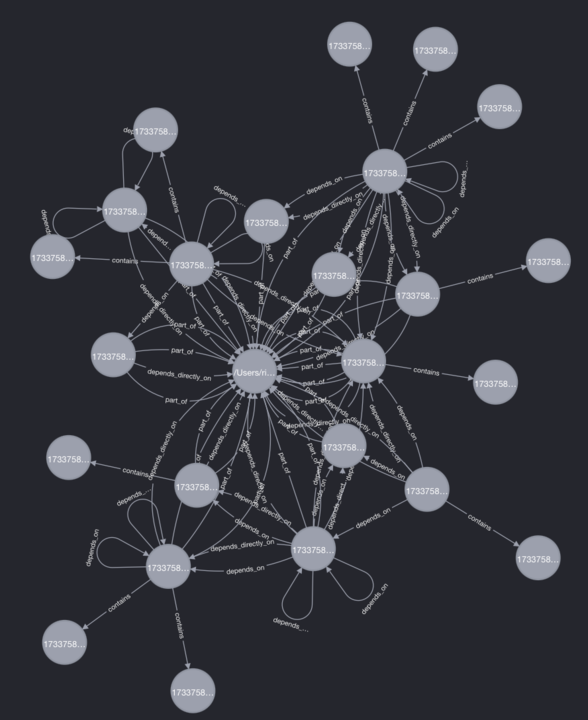
- Ingest the Graph: The LLM has access to structured context from the CodeGraph, so when a developer asks, “Where is the function that parses user inputs for our search engine?”, the LLM can quickly locate that function by following the graph’s relationships rather than brute-forcing file searches.
-
Provide Context-Rich Suggestions:
When the coding copilot suggests a code snippet, it can reference related modules, highlight deprecations, or warn about known compatibility issues. For example, “You might want to call
FunctionParseUserInputfromUtils/InputProcessor.js. It’s used inSearchEngine.jsand depends onInputSchema.json.” -
Explain Architectural Decisions:
Developers can query the LLM about architectural choices: “Why does
ServiceDdepend onServiceE?”. The LLM, using the CodeGraph, responds: “ServiceD callsServiceE’s authentication endpoint to validate tokens, as documented inServiceE/docs/auth.md.” -
Link to Documentation and Commit Histories:
The LLM can connect a piece of code to its associated design docs, recent commit messages, or open pull requests. If a developer asks, “How has
UserProfileAPI.jschanged over the last quarter?” the LLM can summarize major refactoring steps, point to relevant issues that were closed, and link to architectural decision records.
Outcomes:
- Improved Developer Productivity: Instead of wading through multiple repositories, developers get immediate, context-aware guidance, saving countless hours of manual searching and guesswork.
- More Accurate Code Suggestions: Coding copilots armed with a CodeGraph context deliver more reliable and secure code completions, better refactoring strategies, and insightful recommendations.
- Evolving with the Codebase: As repositories grow, the CodeGraph and the LLM continuously update. This ensures that as code evolves, the memory and context available to developers—and their automated assistants—stays fresh and relevant.