

Data Pipeline 1 — Session learning
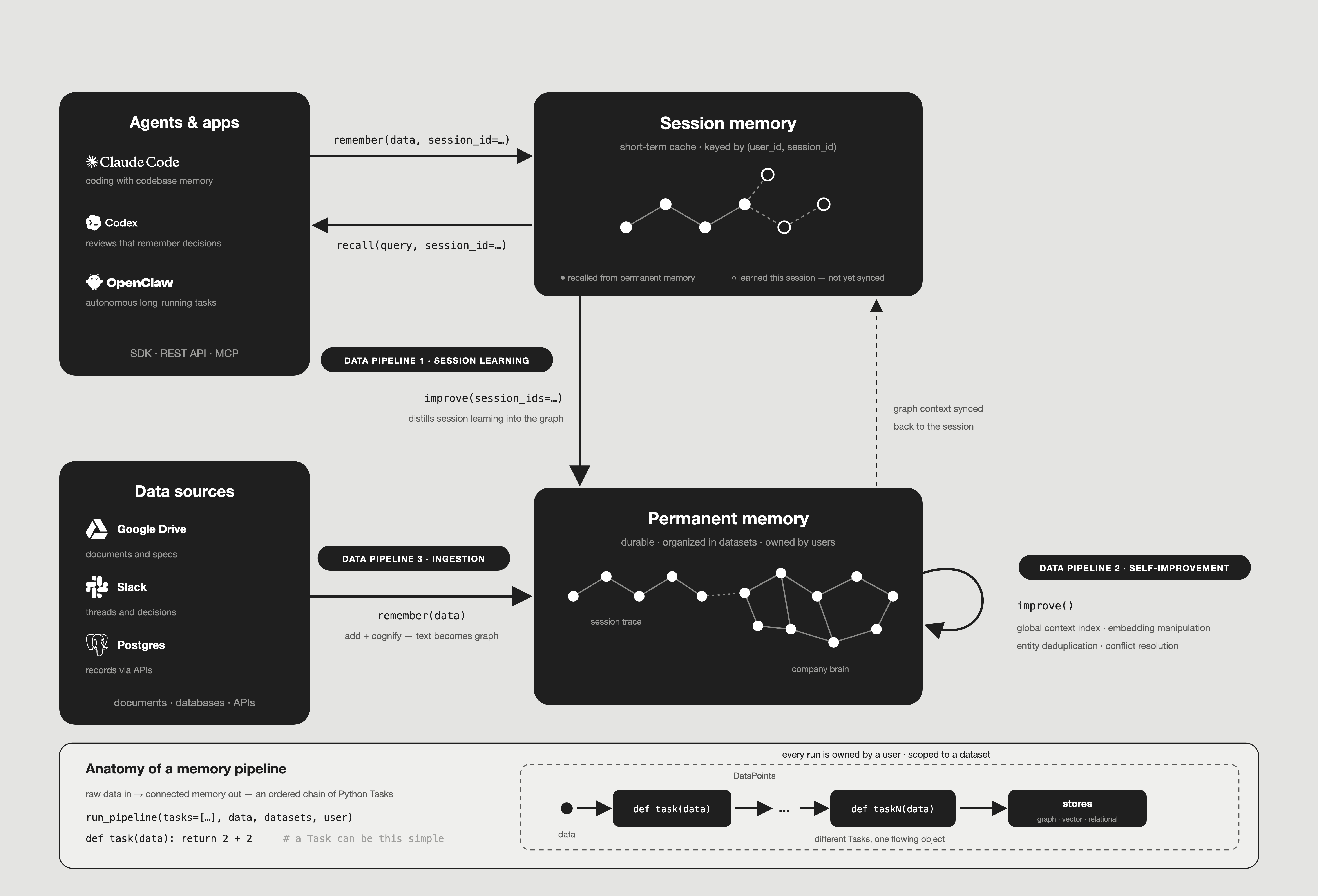
Agents — Claude Code coding with codebase memory, Codex reviews that remember decisions, an OpenClaw agent on a long-running autonomous task — write conversation turns, feedback, traces, and guidance into session memory withremember(data, session_id=...). These writes are raw and fast — no chunking, no graph extraction — which is exactly why they don’t reach the permanent graph on their own. In the diagram they are the hollow nodes in the session graph: learned this session, not yet synced.
The session-learning pipeline is what bridges them. improve(session_ids=[...]) distills gated session guidance into curated lesson documents, persists session Q&A and agent traces into the graph, and applies feedback weights so graph elements that helped produce well-rated answers become more influential in later retrieval. With self_improvement=True (the default for session writes), this pipeline starts automatically in the background; with self_improvement=False, session content stays in the cache until you run improve() yourself.
Data Pipeline 2 — Self-improvement
Once data is in the permanent graph, the self-improvement pipeline enriches it in place. Runningimprove() on a dataset adds derived retrieval structures on top of the existing graph — for example triplet indexes, and optionally dataset-level bucket and root summaries via the global context index — so later recall works better without re-ingesting anything.
This pipeline is also how permanent memory feeds back into session learning: after enrichment, new graph relationships can be synced back into the session cache as readable context — the filled nodes in the session graph above are exactly this recalled core — making future session recall faster and better grounded.
Data Pipeline 3 — Ingestion
Callingremember(data) without a session_id — on anything from Google Drive documents to Slack threads to Postgres records — writes straight to permanent memory. Under the hood this runs the Add + Cognify pipeline: documents are loaded and chunked, entities and relationships are extracted into the knowledge graph, embeddings are indexed in the vector store, and provenance is tracked in the relational store.
How the two memories meet at read time
Retrieval ties the flows together.recall(query, session_id=...) checks the session cache first; on a cache miss it falls through to the permanent knowledge graph, and results are tagged with the _source they came from. Combined with the sync-back from Data Pipeline 2, the session and the graph continuously exchange context in both directions.
Anatomy of a memory pipeline
All three flows above — and any pipeline you build yourself — share one structure: a Pipeline is an ordered sequence of Tasks, where each Task transforms data and passes DataPoints to the next until results land in the stores. In practice a Task is just a Python function — plain function, coroutine, or generator — wrapped inTask(...) so Cognee can batch it, handle its errors, and stream its output into the next step. Even something as trivial as def task(data): return 2 + 2 is a valid Task; the power comes from chaining them over the same flowing object. The task1 → … → taskN chain in the diagram is exactly how the built-in operations run internally, with tasks like extract_chunks_from_documents, extract_graph_from_data, and add_data_points.
Every run is owned: it executes on behalf of a user against a dataset, and user access to datasets and files is verified at each layer. That means the built-in pipelines and your custom ones follow the same rules — swap in your own Tasks, give the pipeline a unique name, and it runs with the same ownership, status tracking, and per-dataset serialization as the defaults.
Pipelines
How pipeline runs, caching, and per-dataset locking work
Improve
The operation behind session learning and self-improvement
Sessions and Caching
How short-term session memory works and expires